
Jev: a model that returns a decision, not a sentence
Most of the work companies hand to language models is not writing. It is decisions: which department this message belongs to, whether this invoice needs approval, how urgent this ticket is. A language model answers that with a sentence you then have to take apart. Jev answers with a value your program reads directly.
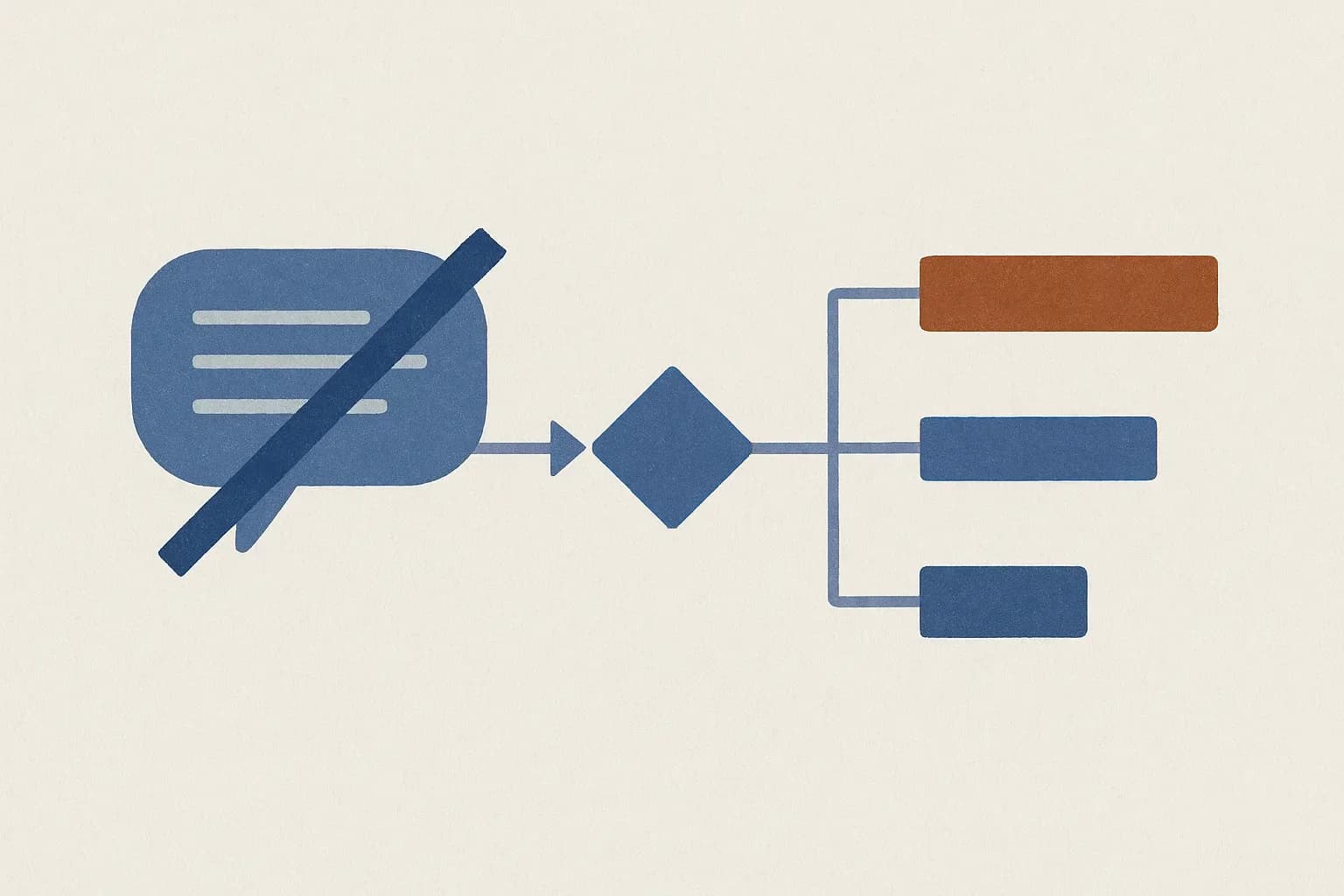
A message lands in the company inbox and has to be assigned to one of six departments. If a language model does that today, it goes roughly like this: you send the text with an instruction, the model writes a sentence, your code pulls a department name out of that sentence, then checks whether it is really one of the six allowed names, because sometimes it is not. You pay for every word of that answer and wait while the model writes them out one at a time.
All of that exists to obtain one of six values. On 15 September 2026 TypeSafe AI opened limited access to a model built for exactly this case. It is called Jev and it generates no text whatsoever. It returns the chosen option along with a probability for each of the others.
The company was founded in San Francisco in 2024 by Diogo Almeida, Erik Gafni and Sasha Sheng. Almeida had spent about four years at OpenAI on RLHF, InstructGPT, ChatGPT and GPT‑4. The launch came with a $40 million seed round led by DCVC. Almeida explains his departure in one line: we have lightning in a bottle and cannot use it, because it was optimised for human language rather than for automation.
Three shapes of question
Jev takes a question in one of three shapes, and that is the whole interface. There is no room for an arbitrary instruction here, because there is no arbitrary answer either.
- A choice from a list. You supply a closed set of options and get one back with a probability for each. Up to 255 options.
- A score on a scale. You supply ordered levels, say from “drop everything” to “this can wait”, and get a level with the distribution across all of them.
- A judgement on a statement. You supply a claim and get a number between 0 and 1, meaning how true the model holds it to be.
The difference from a language model does not stop at the answer format. A language model writes token after token, so its response time grows with the length of the answer. Jev computes all outputs in parallel in a single query, because there is nothing to append. It is trained by a method the company calls RLCD, where probabilities are tuned against actual outcomes rather than against the preferences of human raters. TypeSafe also states that the training data is entirely synthetic.
The probability is not decoration. If it is calibrated, a score of 0.9 really does mean nine hits in ten, and you can put a threshold on it: above the line the system runs on its own, below it the case goes to a person or to a more expensive model. You cannot build that on a bare sentence from a language model.
The numbers the vendor gives
Everything below comes from the TypeSafe AI announcement, which is to say from the company selling the model. Read them with that in mind, because the company itself describes them as the upper end of what shows up in practice.
- Response times of 70 to 500 milliseconds, against 3 to 329 seconds for frontier language models on the same tasks.
- 40 to 200 times faster at comparable decision quality. On one internal workflow, 193.6 times faster and 444.6 times cheaper.
- $0.042 per million input tokens, or $42 per billion. Output tokens are free, on the grounds that there are too few of them to be worth metering.
- Zero format errors, guaranteed by how the model is built rather than measured. The answer can only be one of the values you supplied.

The numbers from outside the company
This is the part that decides it. TechCrunch reported two deployments at outside teams. Vercel used Jev as a safety classifier and reports results 5 to 18 times faster than on OpenAI's Luna 5.6, at higher accuracy. Bryo AI classifies email with it and reports costs 10 to 20 times lower than on Gemini, with calibrated confidence thrown in.
These are still figures from satisfied users rather than an independent measurement, but the order of magnitude is lower than the vendor's own, and that is a good sign rather than a bad one. Armin Ronacher, CTO of Earendel, adds one caveat: the value of a model like this depends on whether you can interpret the confidence it returns. The number settles nothing on its own if nobody has decided what happens below the threshold.
What Jev will not do
- It will not write a sentence, a summary or a line of code. Giving up text generation is deliberate here, and permanent.
- It will not handle more than 255 options, so it will not file a ticket into one of a thousand product categories.
- It will not replace a language model anywhere a human reads the answer.
- It has no published paper and no released weights. The architecture and the training method remain a company's account of itself.
- It is in limited early access, so planning a production rollout for September 2026 means planning from a waiting list.
Where this pays off in a smaller company
Anywhere the decision is simple, repeats thousands of times a day, and today either costs too much or is made by a person.
- Routing email and tickets to the right team, with a confidence threshold below which they land in a general queue instead.
- A first pass over documents ahead of a more expensive model, which then reads only what actually needs reading.
- Scoring urgency in a service queue, where response time matters and eloquence does not.
- Watching an existing AI deployment: checking every answer a language model gives costs so much today that nobody checks them all.
Four things to check before you build a process on it
- 01Whether your decision genuinely fits a closed list of at most 255 entries, and if not, whether it splits into two questions.
- 02How many decisions a day you make at that point. Below a few thousand, the price difference will not repay the cost of changing anything.
- 03What happens to a case that falls below the confidence threshold. If the answer is “nothing”, the threshold does no work.
- 04Whether you have your earlier decisions on record. Without them you cannot measure whether the model beats what you already do.