Foundation models are learning numbers, not just words
A foundation model is trained once on a great deal of data and then handles many different jobs without being retrained. That is how ChatGPT works on text. Over the past year and a half the same recipe has reached numbers: tables, transactions and time series, which is exactly what your company has been collecting for years.
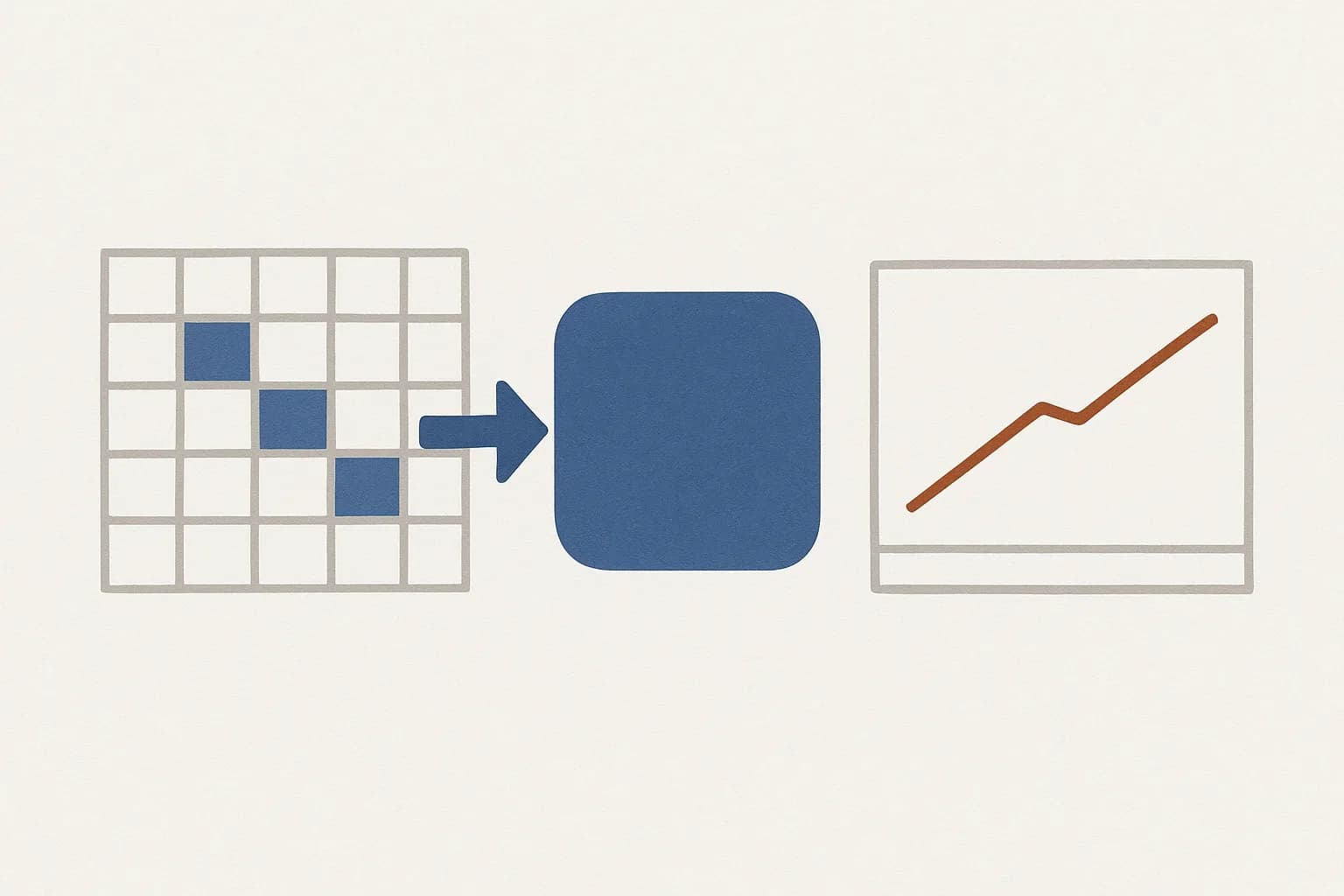
For the past decade, machine learning in companies always looked the same. Every question got its own model: one for the sales forecast, one for risk, one for recommendations. Each had its own data, its own feature preparation and its own maintenance. The bulk of the time went not into the training but into shaping data for one specific question.
One model instead of ten
A foundation model reverses that order. First one large model is trained on a huge amount of data with no particular task in mind, and only then is it pointed at question after question. With text we know this from ChatGPT. What is new is that the same recipe started working on numbers, and working better than the methods that had ruled tables for years.
TabPFN: predictions without training a model
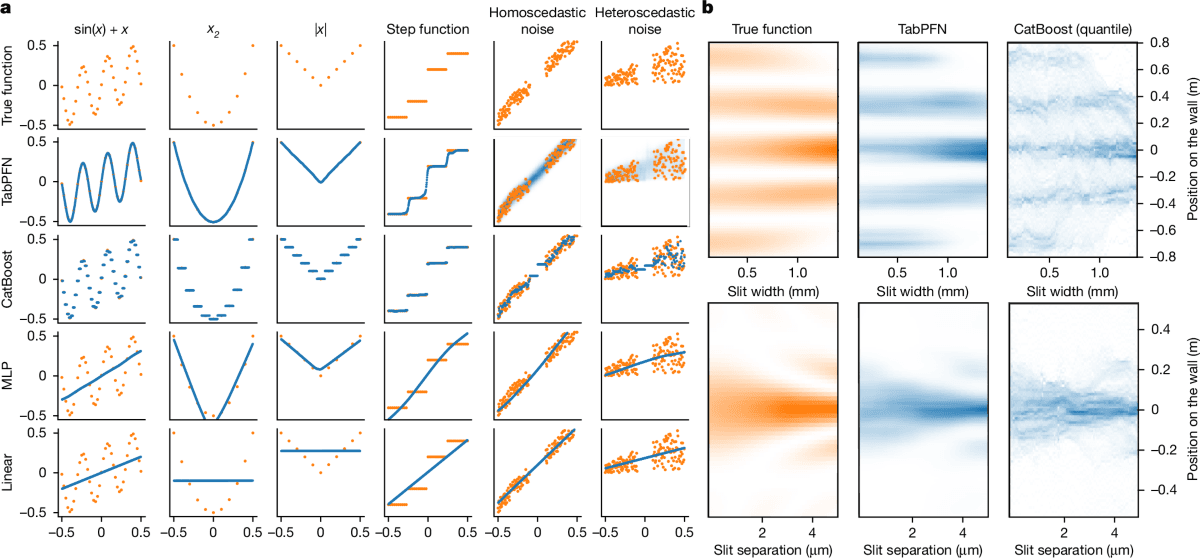
TabPFN works on ordinary tables: rows, columns, and one column to predict. It was described in Nature in January 2025 and is developed by Prior Labs, founded by the authors of that paper. The strange part is that the model never trains on your data. It was trained in advance on roughly 130 million synthetically generated datasets. Your table goes in, and predictions come out in a single pass, with no tuning.
- The version in the Nature paper handles datasets up to 10,000 rows and 500 columns.
- Its abstract reports that it beats gradient boosted trees tuned for four hours, at a speedup of about 5,140 times for classification.
- TabPFN 2.5 raised the ceiling to 50,000 rows and 2,000 columns and matches the accuracy of AutoGluon tuned for four hours.
- TabPFN 3, from May 2026, takes a million rows and 200 columns.

PRAGMA: 24 billion events from one bank
Revolut went the other way and used its own history. PRAGMA is a family of models from 10 million to a billion parameters, trained on 24 billion banking events from 26 million users across 111 countries, which came to 207 billion tokens over 25 months. An event here is not only a payment but also opening the app or changing an account setting. One shared model supports the jobs that used to need separate systems: scoring, fraud, recommendations and several more.

The results are uneven, which is exactly why they are worth reading. Credit scoring improved by 130.2 percent on PR‑AUC. Fraud detection catches 64.7 percent more cases, and at higher precision. Product recommendations gained 40.5 percent. Customer lifetime value barely moved, and anti-money laundering came out 47.1 percent worse than the system it replaced.
The write-up also mentions something that matters more in practice than any single metric: feature preparation, the most expensive stage of a classical project, dropped from months to almost nothing, because the model takes the raw event history instead of hand-computed indicators. The smallest model in the family trained in about two days on sixteen cards.
Synthefy: models for time series
The third example is much earlier on the timeline. In August 2026 Synthefy raised 6.5 million dollars for foundation models built for structured data: tables, signals and time series. Among other things the company promises synthetic time series generated from a text description, so that solutions can be tested without touching real customer data. For now that is an announcement and funding rather than peer reviewed results, so treat it as a signal of direction, not a finished tool.
What this means for a company with no AI team
- Your data is already the right shape. An orders table or a transaction history is exactly the material these models work on.
- A small dataset stopped being an obstacle. Up to tens of thousands of rows, the new models beat methods that needed weeks of tuning.
- The most expensive stage gets cheaper. If the model takes raw history, less time goes into preparing features by hand.
- Order in the data still decides. No foundation model repairs inconsistent identifiers or missing dates.
What these results do not promise
A result in a paper is a result on the authors' data. Revolut had 24 billion events, you probably do not, and one of their seven tasks still came out worse. TabPFN is excellent on a small table and will not replace a recommendation system running on millions of events. The only test that counts is your data, against a measure of success agreed before anything is switched on.
If you want to know whether any of these approaches fits a process of yours, write to us. Usually one table and one question it should answer is enough to start.
Sources
- 01Hollmann et al., Accurate predictions on small data with a tabular foundation model, Nature 637 (2025)
- 02Prior Labs, TabPFN‑2.5 model report
- 03Prior Labs, TabPFN‑3 technical report
- 04Ostroukhov et al., PRAGMA: Revolut Foundation Model, arXiv 2604.08649
- 05NVIDIA, Revolut case study
- 06Synthefy, seed round announcement, August 2026